
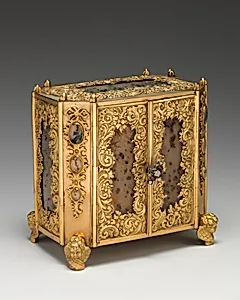
Miniature cabinet
Unknown Artist
18th–19th century
Medium
Gold, agate, lacquer
Dimensions
Overall: 3 3/4 × 3 3/4 × 2 1/2 in. (9.5 × 9.5 × 6.4 cm)
Classification
Metalwork-Gold and Platinum
Culture
British with Japanese decoration
Department
European Sculpture and Decorative Arts
Museum
Metropolitan Museum of Art, New York, NY
Credit
Gift of Admiral F. R. Harris, in memory of his wife, Dena Sperry Harris, 1948
Accession Number
48.185.2
Rights
Public Domain
Art Historical Context
This exquisite miniature cabinet, crafted in the 18th–19th century, exemplifies the opulent world of British decorative arts infused with Japanese influences. Measuring just 3¾ × 3¾ × 2½ inches, it is a marvel of precision metalwork, fashioned from gleaming gold, polished agate, and intricatequer. Likely intended as a luxurious curiosity or personal vanity item, its diminutive scale invited intimate admiration, reflecting the era's fascination with collecting and connoisseurship among Europe's elite. The cabinet's cultural fusion highlights Britain's growing engagement with East Asian aesthetics during the Age of Enlightenment and early industrialization. Japanese lacquer techniques—renowned for their durability and glossy finishes—were prized imports, often adapted in British workshops to evoke exotic allure. Gold and agate added a regal sparkle, underscoring the object's status as a symbol of wealth and global trade networks that connected European courts with distant artisans. Today, housed in The Metropolitan Museum of Art's Department of European Sculpture and Decorative Arts, this gift from Admiral F. R. Harris in 1948 invites visitors to ponder the artistry of the unknown maker. It stands as a testament to cross-cultural exchange, where Eastern precision met Western extravagance in a tiny treasure.