
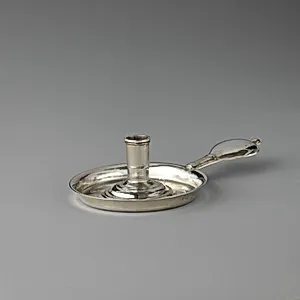
Miniature chamberstick
18th century
Medium
Silver
Dimensions
3 5/8 × 2 1/8 in. (9.2 × 5.4 cm)
Classification
Metalwork-Silver-Miniature
Culture
British, London
Department
European Sculpture and Decorative Arts
Museum
Metropolitan Museum of Art, New York, NY
Credit
The Joseph M. and Aimee Loeb May Collection, 1963
Accession Number
63.53.193
Rights
Public Domain
Art Historical Context
This exquisite *Miniature chamberstick* London silversmith David Clayton the refined artistry of 18th-century silverwork. Crafted in gleaming silver, this diminutive piece measures just 3 5/8 × 2 1/8 inches (9.2 × 5.4 cm), capturing the form of a functional chamberstick—a handheld candlestick with a drip pan and handle designed for safely carrying a lit candle through dimly lit chambers at night. Hallmarked for London, it reflects the city's prestigious guild standards, where makers like Clayton produced high-quality metalwork for affluent households. Miniature silver objects like this one surged in popularity during the Georgian era, serving as delightful collectibles, desk ornaments, or even components of dollhouses for the elite. Clayton's precise craftsmanship highlights advanced silversmithing techniques, such as chasing and engraving, which imbued these tiny treasures with elegant detailing despite their scale. Far from mere novelties, they symbolized wealth and connoisseurship, bridging utility and luxury in everyday domestic life. Housed in The Metropolitan Museum of Art's European Sculpture and Decorative Arts department as part of The Joseph M. and Aimee Loeb May Collection (1963), this chamberstick invites visitors to marvel at the intricate world of 18th-century British material culture, where even the smallest items shone with sophistication.
About the Artist
David Clayton · 1659–1719
David Clayton was an American artist active during the New Deal era who contributed to the Index of American Design, the federal government's sweeping effort to document American decorative arts and folk traditions through watercolor illustration. Organized under the Works Progress Administration's Federal Art Project beginning in 1935, the Index employed artists in thirty-four states to render ev...