
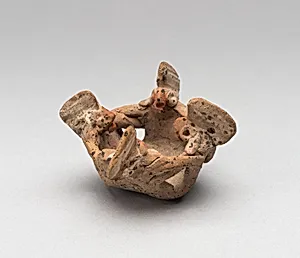
Miniature Group of Four Figures in a Circle with Linked Arms
500–300 BCE
Medium
Ceramic and pigment
Dimensions
H.: 13.5 cm (3/8 in.)
Classification
earthenware
Department
Arts of the Americas
Museum
Art Institute of Chicago
Accession Number
24642
Rights
Public Domain
Art Historical Context
This charming miniature ceramic sculpture, created by artists of the Chupícuaro culture in west-central Mexico between 500 and 300 BCE, captures four figures standing in a tight circle with arms linked. Standing just 13.5 centimeters tall, the work exemplifies the intimate scale often favored in Chupícuaro pottery, which was produced long before the rise of later Mesoamerican civilizations. The figures, modeled in earthenware and enhanced with mineral pigments, appear to engage in a shared activity—possibly a dance or ritual—suggesting themes of community and connection that resonated deeply in ancient daily life. Chupícuaro potters were renowned for their skillful hand-building techniques and use of slip and pigment to add color and detail to their creations. Although the exact function of this piece remains unknown, its compact size and group composition imply it may have served as a personal offering or ceremonial object placed in burials. Such works provide rare glimpses into the social values of a culture that flourished along the Lerma River, emphasizing collective bonds through art. Today, this delicate group invites viewers to appreciate the enduring human impulse to represent togetherness, preserved across more than two millennia in the permanent collection of the Art Institute of Chicago.