
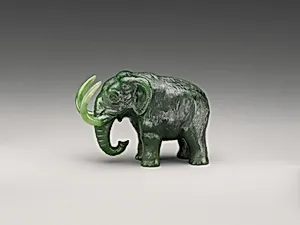
俄國 十九世紀 玉猛獁象|Miniature mammoth of Siberia
Unknown Artist
1900
Medium
Jade (nephrite)
Dimensions
W. 1 7/8 in. (4.8 cm); D. 1 5/16 in. (3.3 cm); L. 2 11/16 in. (6.8 cm)
Classification
Jade
Culture
Russia
Department
Asian Art
Museum
Metropolitan Museum of Art, New York, NY
Credit
Gift of Heber R. Bishop, 1902
Accession Number
02.18.807
Rights
Public Domain
Tags
Art Historical Context
This exquisite miniature mammoth, carved from nephrite jade, captures the prehistoric majesty of Siberia's ancient giants. Dating to 1900 and attributed to an unknown Russian artist, the sculpture measures just 2⅞ inches long, showcasing remarkable precision in a compact form. Nephrite, a tough variety of jade prized for its durability and lustrous green hue, was sourced from Siberian deposits, linking the artwork directly to the region's geology and paleontological fame—home to numerous woolly mammoth fossils discovered in the 19th century. In late 19th- and early 20th-century Russia, jade carving flourished as a luxury craft, often inspired by natural history and imperial collecting tastes. This piece reflects that era's fascination with extinct megafauna, blending artistic skill with scientific curiosity. The intricate detailing of the mammoth's tusks, trunk, and shaggy form demonstrates masterful techniques in incising and polishing hardstone, a nod to both Russian lapidary traditions and broader Asian jade-working influences. A gift to the Metropolitan Museum of Art from collector Heber R. Bishop in 1902, this rare survivor invites visitors to ponder humanity's awe for Ice Age wonders, preserved in enduring stone. Housed in the Asian Art department, it bridges cultures through shared appreciation for jade's timeless allure.