
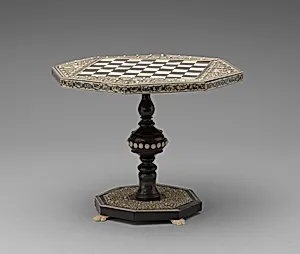
Miniature pedestal table with inlaid chessboard
Unknown Artist
19th century
Medium
Ivory, horn, wood
Dimensions
Overall (confirmed): 8 1/8 × 10 1/2 × 10 1/2 in. (20.6 × 26.7 × 26.7 cm)
Classification
Chess Sets
Culture
Indian
Department
European Sculpture and Decorative Arts
Museum
Metropolitan Museum of Art, New York, NY
Credit
Gift of Gustavus A. Pfeiffer, 1948
Accession Number
48.174.67
Rights
Public Domain
Art Historical Context
This exquisite miniature pedestal table with an inlaid chessboard, crafted in 19th-century India, showcases the region's masterful decorative arts. Standing just over 8 inches tall and 10½ inches square, it is ingeniously constructed from ivory, horn, and wood—materials prized for their durability and luminous qualities. The chessboard is artfully inlaid into the tabletop, transforming a functional game piece into a portable luxury object, perfect for travel or intimate gatherings. Chess, known anciently in India as *chaturanga* (the "four divisions" of the army), originated there around the 6th century before evolving into the global game we know today. This table reflects that enduring cultural legacy, blending utility with fine craftsmanship typical of Mughal-influenced workshops. The use of ivory and horn for inlays highlights skilled marquetry techniques, where contrasting materials create a visually striking checkered pattern that catches the light beautifully. A gift to the Metropolitan Museum of Art from Gustavus A. Pfeiffer in 1948, this piece now resides in the European Sculpture and Decorative Arts department, underscoring colonial-era exchanges between India and the West. Visitors will appreciate its delicate scale and historical depth—a testament to India's artistic ingenuity.