
Miniature Square-Headed Brooch
Unknown Artist
500–550
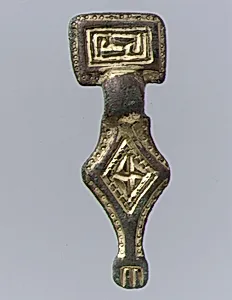
Medium
Silver-gilt; iron pin
Dimensions
Overall: 1 3/4 x 5/8 x 3/8 in. (4.5 x 1.6 x 0.9 cm)
Classification
Metalwork-Silver
Culture
Anglo-Saxon
Department
Medieval Art
Museum
Metropolitan Museum of Art, New York, NY
Credit
Gift of J. Pierpont Morgan, 1917
Accession Number
17.191.46
Rights
Public Domain
Art Historical Context
This exquisite Miniature Square-Head Brooch, crafted by an unknown Anglo-Saxon artisan around 500–550 CE, exemplifies the masterful metalwork of early medieval England during the Migration Period. Anglo-Saxon brooches like this one were essential fasteners for cloaks and garments doubling as symbols of status and identity. Its square-headed design is a hallmark of the era, reflecting the intricate jewelry traditions that bridged pagan and emerging Christian influences in post-Roman Britain. Made of silver-gilt with an iron pin, theoch showcases sophisticated techniques: the silver base was gilded—likely with gold leaf or mercury amalgamation—for a luxurious sheen that mimicked solid gold. At just 1 3/4 x 5/8 x 3/8 inches, its miniature scale highlights the jeweler's precision, suggesting it was a high-status personal item, possibly from a grave or hoard. Housed in the Metropolitan Museum of Art's Medieval Art Department (gift of J. Pierpont Morgan, 1917), this tiny treasure offers a window into Anglo-Saxon craftsmanship and daily life, reminding us how even small objects carried profound cultural weight in a turbulent time.