
Miniature Square-Headed Brooch
Unknown Artist
first half 6th century
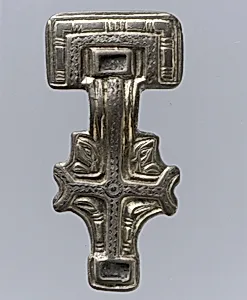
Medium
Silver-gilt, niello, inlays lost
Dimensions
Overall: 7/8 x 1 13/16 x 3/8 in. (2.2 x 4.6 x 1 cm)
Classification
Metalwork-Silver
Culture
Anglo-Saxon
Department
Medieval Art
Museum
Metropolitan Museum of Art, New York, NY
Credit
Gift of J. Pierpont Morgan, 1917
Accession Number
17.191.49
Rights
Public Domain
Art Historical Context
This exquisite Miniature Square-Headed Brooch, in the first half of the 6th century by an unknown Anglo-Saxon artisan, exemplifies the masterful metalwork of early medieval England. Measuring just 7/8 x 1 13/16 x 3/8 inches, its petite scale belies its intricate design, typical of square-headed brooches worn to fasten cloaks or adorn garments. Made of silver-gilt—silver coated with a thin layer of gold for a luxurious sheen—the piece once featured niello inlays, a technique where black silver sulfide was engraved into the metal, fired, and polished for striking contrast. Sadly, the colorful inlays, likely garnets or glass, have been lost to time. Hailing from the Anglo-Saxon culture that emerged in Britain after the Roman withdrawal, such brooches were status symbols for the elite, often found in high-status burials. They reflect the fusion of Germanic artistic traditions with local innovation, showcasing filigree, chip-carving, and zoomorphic motifs that hinted at mythical creatures or interlaced patterns. The square-headed form, with its broad, decorated head tapering to a foot, was a hallmark of 5th-6th century Kentish workshops, signaling wealth and cultural identity amid the turbulent Migration Period. Today, this rare survivor graces the Metropolitan Museum of Art's Medieval Art collection, a gift from J. Pierpont Morgan in 1917. It invites us to marvel at the Anglo-Saxons' technical prowess and aesthetic sophistication, bridging the gap between pagan antiquity and Christian medieval Europe.