
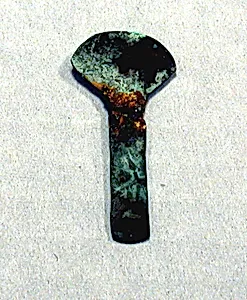
Miniature Tumi
Unknown Artist
1st–8th century
Medium
Copper
Dimensions
H. 1 3/4 × W. 13/16 in. (4.4 × 2.1 cm)
Classification
Metal-Ornaments
Culture
Moche; Chimú or Chancay
Department
Arts of Africa, Oceania, and the Americas
Museum
Metropolitan Museum of Art, New York, NY
Credit
Gift of Mr. and Mrs. Nathan Cummings, 1964
Accession Number
64.228.437
Rights
Public Domain
Tags
Art Historical Context
This exquisite **Miniature Tumi**, from copper around the 1st–8th century, hails from the vibrant cultures of ancient Peru—likely Moche, with possible ties to Chimú or Chanc peoples. Measuring just 1 3/4 inches tall, this tiny metal ornament embodies the sophisticated metallurgy of the Andean world, where artisans transformed humble copper into symbols of ritual power. Tumis, resembling ceremonial knives with curved blades, were revered tools in sacrifices, lunar worship, and elite ceremonies, blending utility with profound spiritual meaning. Though classified as a metal ornament and tagged as a weapon, its diminutive scale suggests it served as jewelry, an amulet, or votive offering rather than a functional blade. The Moche, masters of early Peruvian art, excelled in such precise casting techniques, often using lost-wax methods to capture intricate details on small scales. Displayed in the Metropolitan Museum of Art's Arts of Africa, Oceania, and the Americas department, this piece—generously gifted by Mr. and Mrs. Nathan Cummings in 1964—offers a window into pre-Columbian innovation, where everyday metals became portals to the divine. (198 words)