
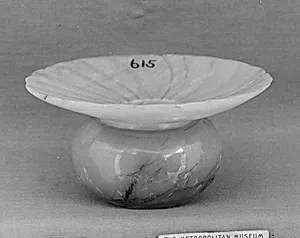
Miniature Vase
Unknown Artist
Medium
Nephrite, white with a light greenish tint and a few russet stainings
Dimensions
H. 1 5/8 in. (4.2 cm); W. 3 1/4 in. (8.3 cm)
Classification
Jade
Culture & Period
China · Qing dynasty (1644–1911), Qianlong period (1736–95)
Department
Asian Art
Museum
Metropolitan Museum of Art, New York, NY
Credit
Gift of Heber R. Bishop, 1902
Accession Number
02.18.615
Rights
Public Domain
Art Historical Context
This exquisite Miniature Vase, from nephrite jade—white with a subtle greenish tint and delicate russet stainings—exemplifies the pinnacle of Chinese jade during the Qianlong period (173695) of the Qing (1644–1911). Standing just 1 5/8 inches (4.2 cm) tall and 3 1/4 inches (8.3 cm) wide, its diminutive size belies the extraordinary technical mastery required to shape such a hard, resilient stone into a flawless vessel form. Nephrite, revered in China for millennia as the "stone of heaven," symbolizes purity, immortality, and imperial virtue, making objects like this prized possessions for the elite. In the Qianlong era, often called a golden age of Chinese arts patronage, the emperor himself was a fervent collector and commissioner of jade works, fostering workshops that produced unparalleled refinements. Artisans exploited the stone's natural color variations—here, the light green hues and russet "skin" markings—to enhance aesthetic appeal, turning imperfections into artistic virtues. This vase likely served as a decorative scholar's object or incense holder, reflecting the period's blend of functionality and opulent connoisseurship. A generous gift to the Metropolitan Museum of Art from Heber R. Bishop in 1902, this piece invites visitors to marvel at the patience and precision of anonymous Qing craftsmen, whose legacy endures in every polished curve.