
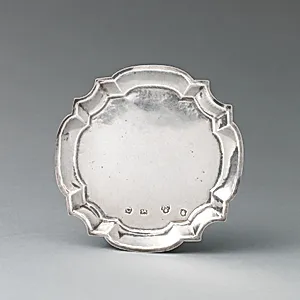
Miniature waiter
1739/40
Medium
Silver
Dimensions
Overall: 1 5/16 × 3 3/8 in. (3.3 × 8.6 cm)
Classification
Metalwork-Silver-Miniature
Culture
British, London
Department
European Sculpture and Decorative Arts
Museum
Metropolitan Museum of Art, New York, NY
Credit
The Joseph M. and Aimee Loeb May Collection, 1963
Accession Number
63.53.5
Rights
Public Domain
Art Historical Context
Nestled in the Metropolitan Museum of Art's European Sculpture and Decorative Arts, *Miniature Waiter* is a delightful silver figurine crafted by London silversmith John Le in 1739/40. Measuring just 1 5/16 × 3 /8 inches (3.3 × 8.6 cm), this tiny masterpiece exemplifies the exquisite miniaturization prized in 18th-century British metalwork. Le Sage, active in London's thriving silver trade, hallmarks his work with the lion passant and maker's mark, attesting to its authenticity from the George II era. In the opulent world of Georgian England, such miniature silver objects were coveted novelties for affluent households—perhaps adorning dressing tables, serving as whimsical desk ornaments, or even functioning as chatelaine attachments. The medium of silver, polished to a gleam and likely chased or engraved with fine detail, highlights the silversmith's technical prowess in capturing human form at such a diminutive scale. Rococo influences may whisper through its playful subject—a poised waiter, evoking the era's love for elegant domestic scenes. This piece, from The Joseph M. and Aimee Loeb May Collection (1963), underscores the cultural prestige of British silver craftsmanship, blending utility with artistry in a form that invites close inspection and sparks wonder at human ingenuity.