
Mirror
Unknown Artist
17th century
Medium
Silver
Dimensions
Overall: 3 1/2 × 2 3/4 in. (8.9 × 7 cm)
Classification
Costume Accessories
Culture
French
Department
European Sculpture and Decorative Arts
Museum
Metropolitan Museum of Art, New York, NY
Credit
Gift of Mrs. Edward S. Harkness, 1930
Accession Number
30.135.89
Rights
Public Domain
Art Historical Context
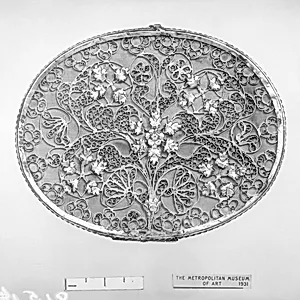
This exquisite 17th-century French silver mirror, measuring just 3½ × 2¾ inches, is a delicate costume accessory designed for personal portability—likely tucked into a pocket or reticule by fashionable aristocrats of the Baroque era. Crafted from gleaming silver, its surface is adorned with intricate motifs of flowers and leaves, showcasing the era's mastery of repoussé or chased techniques that brought organic elegance to everyday luxury items. Such mirrors were not mere tools for grooming but status symbols, reflecting the opulence of Louis XIV's court where even the smallest objects exuded refinement. In the context of European decorative arts, this piece highlights French silversmiths' unparalleled skill in miniaturizing grandeur. During the 17th century, silver's malleability allowed for detailed floral engravings symbolizing beauty and renewal, aligning with the period's fascination with nature amid lavish court life. As a rare survivor of personal adornments, it offers a glimpse into the intimate world of elite fashion, where mirrors doubled as vanities evoking both self-admiration and subtle social display. Generously gifted to The Metropolitan Museum of Art in 1930 by Mrs. Edward S. Harkness, this mirror invites visitors to ponder the artistry hidden in the handheld, bridging the grandeur of Versailles with our own reflections.