
Mirror
Unknown Artist
12th–13th century
Medium
Bronze; cast, chased
Dimensions
W. 3/8 in. (1 cm) Diam. 8 11/16 in. (22 cm)
Classification
Metal
Department
Islamic Art
Museum
Metropolitan Museum of Art, New York, NY
Credit
Gift of Florence E. and Horace L. Mayer, 1978
Accession Number
1978.348.2
Rights
Public Domain
Tags
Art Historical Context
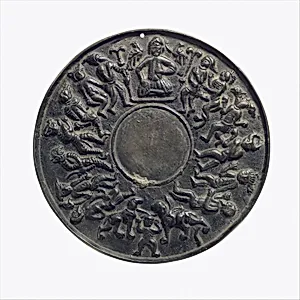
This enchanting bronze hand mirror, crafted by an unknown artist in the 12–13th century,ails from the Islamic world and exemplifies the era's masterful metalworking traditions. Measuring just 8 11/16 inches (22 cm) in diameter a slender 3/8 inch (1 cm) thick, it was designed for personal use, reflecting both daily life and spiritual beliefs in medieval Islamic societies. Now housed in the Metropolitan Museum of Art's Islamic Department (gift of Florence E. and Horace L. Mayer, 1978), it invites visitors to ponder the fusion of utility and artistry. Forged through casting—pouring molten bronze into a mold—and refined with chasing techniques, where fine tools incised intricate details, the mirror showcases the technical prowess of Islamic artisans. Its surface likely features demonic motifs, a common motif in medieval metalwork that may have served apotropaic purposes, warding off evil spirits while gazing upon one's reflection. Such decorations blend folklore with craftsmanship, highlighting bronze's durability and luster as a prized medium. In a time when mirrors symbolized vanity, wisdom, and the supernatural, this piece reveals cultural reverence for protective symbolism. Demons, often stylized in Islamic art, underscore the interplay between the mundane and mystical, making this modest object a window into 12th-century worldview.