
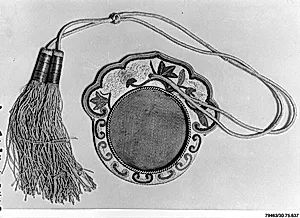
Mirror Case
Unknown Artist
18th–19th century
Medium
Silk
Dimensions
3 1/4 x 3 1/2 in. (8.26 x 8.89 cm)
Classification
Textiles-Embroidered
Culture & Period
China · Qing dynasty (1644–1911)
Department
Asian Art
Museum
Metropolitan Museum of Art, New York, NY
Credit
Bequest of William Christian Paul, 1929
Accession Number
30.75.637
Rights
Public Domain
Art Historical Context
This exquisite **Mirror Case**, crafted in silk during China's Qing dynasty (1644–1911), exemplifies era's mastery of embroidered textiles. Dating to the 18th–19th century, this small—measuring just 3¼ × 3½ inches—was likely designed to protect a personal mirror, a cherished accessory for women in elite households. Qing artisans elevated silk embroidery to an art form, using fine threads to create intricate patterns that symbolized prosperity, longevity, and harmony, reflecting Confucian ideals and imperial splendor. The medium of silk, China's ancient luxury fabric, holds profound cultural significance. Produced along the Silk Road for millennia, it was reserved for high-status objects during the Qing, when the dynasty's prosperity fueled workshops specializing in techniques like satin stitch and knotting. Embroidered textiles like this one were not mere utilities but status symbols, often given as gifts or bridal dowry items, blending functionality with aesthetic refinement. Today, housed in the Metropolitan Museum of Art's Asian Art Department through the 1929 bequest of William Christian Paul, this delicate survivor invites us to appreciate the Qing's textile legacy—where every stitch tells a story of craftsmanship and tradition.