
Mirror disk
Unknown Artist
5th–4th century BCE
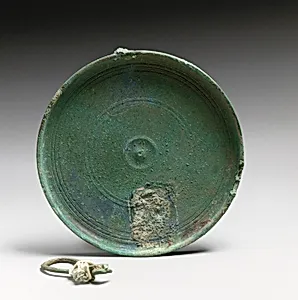
Medium
Bronze
Dimensions
Diameter: 4 3/4 in. (12.1 cm) Height: 3/8 in. (1 cm)
Classification
Bronzes
Culture & Period
Greek, South Italian ? · Classical
Department
Greek and Roman Art
Museum
Metropolitan Museum of Art, New York, NY
Credit
Gift of Mr. and Mrs. Jonathan P. Rosen, 1991
Accession Number
1991.171.48
Rights
Public Domain
Tags
About this artwork
This Mirror disk dating to 5th–4th century BCE exemplifies the artistic traditions of Greek, South Italian ?, Classical. Created in bronze, the work demonstrates technical mastery of materials and processes characteristic of Greek, South Italian ?, Classical artisans. As part of the Metropolitan Museum of Art's Greek and Roman Art, this piece contributes to our understanding of historical artistic production. The work's Diameter: 4 3/4 in. (12.1 cm) Height: 3/8 in. (1 cm) and material qualities ...
Art Historical Context
This elegant bronze mirror disk, dating to the 5th–4th century BCE,ails from the Classical period of Greek culture, possibly produced in South Italy. Measuring just 4 3/4 inches (12.1 cm) in diameter and a mere 3/8 inch (1 cm) thick, it exemplifies the refined craftsmanship of ancient artisans who cast and polished bronze to create functional yet beautiful personal objects. Such mirrors were everyday essentials for grooming, their reflective surfaces achieved through meticulous polishing—a testament to the technical mastery of the era. In the vibrant world of Classical Greece and its colonies, like those in South Italy (Magna Graecia), these disks bridged utility and artistry. Often found in tombs or households, they reveal insights into daily life, beauty rituals, and social status. The choice of bronze, a durable and prestigious alloy of copper and tin, highlights advanced metallurgical skills and trade networks that connected the Mediterranean. Now part of the Metropolitan Museum of Art's Greek and Roman Art collection—thanks to the gift of Mr. and Mrs. Jonathan P. Rosen in 1991—this unadorned yet sophisticated piece invites us to ponder the gazes of long-ago users, offering a tangible link to the aesthetic values and innovative spirit of antiquity.