
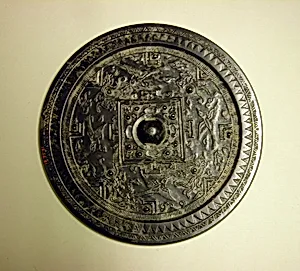
漢 博局鳥獣紋銅鏡|Mirror with board game design and mythical creatures
Unknown Artist
1st century BCE–1st century CE
Medium
Bronze with black patina
Dimensions
Diam. 7 in. (17.8 cm)
Classification
Mirrors
Culture & Period
China · Han dynasty (206 B.C.–A.D. 220)
Department
Asian Art
Museum
Metropolitan Museum of Art, New York, NY
Credit
Rogers Fund, 1918
Accession Number
18.56.81
Rights
Public Domain
Art Historical Context
This exquisite bronze mirror from China's Han dynasty (206 B.C.–A.D. 220) showcases the era's masterful metalwork and cultural sophistication. Dating to the 1st century BCE–st century CE, its 7-inch (17.8 cm) diameter surface features a central board game design known as *liubo*—a popular pastime among Han elites, blending strategy and chance much like modern backgammon. Surrounding it are intricate motifs of mythical creatures and birds and beasts, rendered in shallow relief, evoking the dynasty's fascination with cosmology, immortality, and the natural world. Han mirrors like this one were more than functional toiletries; they served as status symbols, gifts, and grave goods, often symbolizing the reflective soul or cosmic order. Crafted via sophisticated piece-mold casting, the bronze developed its rich black patina over centuries, enhancing its mystical allure. Acquired through the Rogers Fund in 1918, this piece at the Metropolitan Museum of Art offers a window into daily life and spiritual beliefs of ancient China, where art and play intertwined seamlessly.