
Mirror with Jael and Barak
Unknown Artist
1672
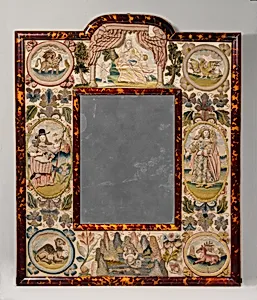
Medium
Satin worked with silk and metal-wrapped thread, beads, purl, mica, seed pearls; detached buttonhole variations, long-and-short, satin, couching, and straight stitches; wood frame, celluloid imitation tortoiseshell, mirror glass, silk plush
Dimensions
28 3/4 x 23 3/4 in. (73 x 60.3 cm)
Classification
Textiles-Embroidered
Culture
British
Department
European Sculpture and Decorative Arts
Museum
Metropolitan Museum of Art, New York, NY
Credit
Purchase, Mrs. Thomas J. Watson Gift, 1939
Accession Number
39.13.2a
Rights
Public Domain
Tags
Art Historical Context
This exquisite *Mirror with Jael and Barak*1672), crafted by an unknown British artist, captures a dramatic biblical scene from the Book Judges, where the heroic Jael slays the Canaanite general Sisera, aided by the Israelite leader Barak. Surrounding the central narrative are fantastical and lively motifs—griffins,ermaids, fish,, deer, men, and women—blending religious storytelling with whimsical Baroque exuberance. Created during England's Restoration era, such embroidered mirrors adorned affluent homes, reflecting the period's fascination with opulent domestic decoration and moral tales from scripture. The artwork's medium is a tour de force of 17th-century embroidery: satin worked with silk and metal-wrapped threads, embellished with beads, purl, mica flakes, and seed pearls. Masterful stitches—detached buttonhole variations for textured effects, long-and-short shading for depth, satin for sheen, couching for metallic outlines, and straight lines for precision—demonstrate extraordinary technical virtuosity, likely the work of a highly skilled needlewoman. Housed in a wood frame with celluloid imitation tortoiseshell, mirror glass, and silk plush backing, it exemplifies the fusion of textile artistry and functional elegance in European decorative arts. Now at The Metropolitan Museum of Art (Purchase, Mrs. Thomas J. Watson Gift, 1939), this piece highlights British embroidery's cultural prestige, transforming a everyday mirror into a shimmering narrative treasure that invites viewers to ponder faith, fantasy, and craftsmanship.