
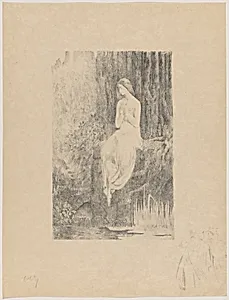
Mélancolie (Melancholy)
1894
Medium
lithograph in black on heavy japan paper
Dimensions
sheet: 36.8 x 28 cm (14 1/2 x 11 in.)
Classification
Department
CG-E
Museum
National Gallery of Art, Washington, D.C.
Credit
Virginia and Ira Jackson Collection, gift in memory of Virginia H. Jackson
Accession Number
1996.151.11
Rights
Public Domain
Art Historical Context
Jean Danguy's *Mélancolie (Melancholy)*, created in 1894, the introspective mood of fin-de-siècle France through a striking black lithograph on heavy japan paper Measuring 36.8 x 28 cm, this intimate print invites viewers into a world of quiet contemplation, its title evoking the pervasive themes of longing and ennui that resonated in late 19th-century European art Danguy, a French printmaker, employs the lithographic process—drawing directly on stone with greasy crayon to transfer ink via water-repellent chemistry—to achieve rich tonal depths and subtle gradations, hallmarks of the medium's expressive potential. The choice of heavy japan paper, prized for its absorbency and durability, enhances the print's velvety texture and longevity, a nod to the era's fascination with Eastern imports and fine craftsmanship. Produced during a time when lithography flourished as a democratic art form, bridging fine art and reproduction, *Mélancolie* reflects the Symbolist impulse to explore inner emotional states amid rapid modernization. Now housed in the National Gallery of Art's Virginia and Ira Jackson Collection—gifted in memory of Virginia H. Jackson—this work exemplifies the technical innovation and psychological depth of 1890s printmaking. Pause before it to feel the weight of unspoken sorrows, a timeless invitation to introspection.
About the Artist
Jean Danguy · 1863–1926
**Jean Célestin Danguy: Symbolist Painter and Printmaker** Born on November 23, 1863, in Gagny, France, at his maternal grandmother Rose Thorel's home—where she directed the local post office—Jean Célestin Danguy grew up in an artistic family. His father, Célestin Danguy, was a history painter renowned for reproducing Franz Xaver Winterhalter's portrait of Napoleon III for public buildings, inclu...