
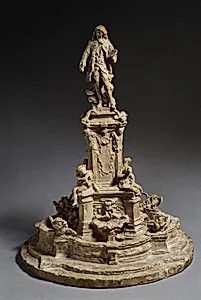
Model for the Watteau Fountain
ca. 1867–68
Medium
Patinated plaster
Dimensions
30 1/8 × 23 1/8 in. (76.5 × 58.7 cm)
Classification
Sculpture
Culture
French
Department
European Sculpture and Decorative Arts
Museum
Metropolitan Museum of Art, New York, NY
Credit
Gift of Yulla Lipchitz, 1991
Accession Number
1991.64
Rights
Public Domain
Tags
Art Historical Context
Jean-Baptiste Carpeaux, leading French sculptor of the Second Empire, created this patinated plaster *Model for the Watteau Fountain* 1867–68. Standing at over inches tall, this dynamic maquette captures exuberant male figures—musicians and revelers in 18th-century attirefrozen in lively poses that evoke joy and movement. It served as a preparatory study for the grand fountain commissioned for the Louvre's gardens in Paris, a tribute to the rococo master Antoine Watteau, whose fêtes galantes inspired the whimsical scene. Carpeaux's neoclassical training blended seamlessly with romantic vitality, making his sculptures pulse with energy and emotion. The patinated plaster medium, mimicking aged bronze, allowed for detailed modeling and surface effects while being practical for workshop trials before casting in final materials. This technique highlights his innovative approach to public monuments during Napoleon III's era of opulent urban renewal. Today, housed in the Metropolitan Museum of Art, the model offers a rare glimpse into Carpeaux's creative process, bridging 17th-century elegance with 19th-century exuberance. A testament to French decorative arts, it reminds us how sculpture could animate city spaces with theatrical delight.
About the Artist
Jean-Baptiste Carpeaux · 1827–1875
Carpeaux's exuberant work was a decisive break from Neoclassical art. He won the Prix de Rome in 1854 and received many portrait bust commissions from the court. His most famous sculpture group is 'La Danse' (1869) made for the Paris Opéra. So bold is its message of bacchanalian revelry that it was vandalized in protest. French artist.