
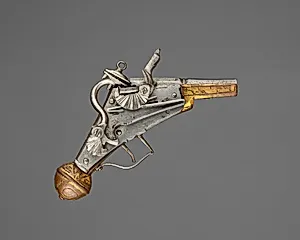
Model of a Miquelet Pistol
Unknown Artist
beginning 17th century
Medium
Steel, copper alloy (brass), gold
Dimensions
L. 3 1/16 in. (7.8 cm); L. of barrel 1 15/16 in. (4.9 cm); Cal. .15 in (3.8 mm); Wt. 2.2 oz. (62.4 g)
Classification
Firearms-Pistols-Miquelet
Culture
German
Department
Arms and Armor
Museum
Metropolitan Museum of Art, New York, NY
Credit
Gift of Jean Jacques Reubell, in memory of his mother, Julia C. Coster, and of his wife, Adeline E. Post, both of New York City, 1926
Accession Number
26.145.363
Rights
Public Domain
Art Historical Context
Step into the intricate world of 17th German arms craftsmanship with this exquisite *Model of a Mique Pistol*, a miniature marvel from the early 1600s. Crafted from steel, copper alloy (brass), gold, this tiny firearm measures just 3 1/16 inches long with a barrel of 15/16 inches a featherlight weight of 2.2 ounces. Housed in the Metropolitan Museum Art's Arms and Armor, it exemplifies the period's mastery of metalworking, where gold accents likely highlighted decorative flourishes on an otherwise functional design scaled down to perfection. The Miquelet pistol, named for its distinctive flintlock mechanism originating in Spain but widely adopted across Europe, represented a technological leap in handheld firearms during the Renaissance and Baroque eras. This German example, gifted to the Met in 1926 by Jean Jacques Reubell, captures that innovation in miniature form—possibly as a collector's piece, instructional model, or even a gentleman's novelty. Its small .15-inch caliber underscores its non-combat purpose, showcasing instead the artisan's skill in forging precise components from durable steel and gleaming brass. Such models offer a window into the cultural prestige of weaponry, blending utility with artistry. They remind us how arms were not just tools of war but symbols of status, their gilded details evoking the opulence of princely courts in the Holy Roman Empire. A delightful gem for visitors fascinated by history's smaller stories! (198 words)