
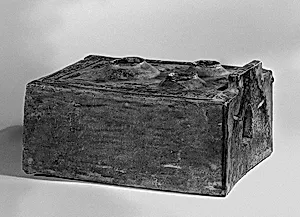
Model of a stove
Unknown Artist
1st–2nd century
Medium
Earthenware with green glaze
Dimensions
H. 4 7/8 in. (12.4 cm); W. 7 in. (17.8 cm); L. 9 1/2 in. (24.1 cm)
Classification
Tomb Pottery
Culture & Period
China · Han dynasty (206 B.C.–A.D. 220)
Department
Asian Art
Museum
Metropolitan Museum of Art, New York, NY
Credit
Gift of Paul E. Manheim, 1966
Accession Number
66.182.1
Rights
Public Domain
Art Historical Context
This charming model of a stove, crafted during China's Han dynasty (206 B.C.–A.D. 220), offers a glimpse into everyday life over 2,000 years ago. Made of earthenware coated in a vibrant green glaze, measures a compact 4⅞ inches high, 7 inches wide, and 9½ inches long—perfectly scaled for its ritual purpose. The glossy green finish, achieved through early lead-glazing techniques, was a Han innovation that protected the clay and added a lively, jewel-like sheen, marking a pivotal advancement in Chinese ceramics. As tomb pottery (mingqi), this piece was buried with the deceased to furnish their afterlife, reflecting Han beliefs in an eternal, mirrored existence. Stoves like this symbolized the hearth's central role in the home, ensuring the spirit's comfort with practical comforts. Such models, mass-produced yet meticulously detailed, highlight the dynasty's prosperity and mass burial rituals, where thousands of similar artifacts equipped tombs across the empire. Today, this gift to the Metropolitan Museum of Art from Paul E. Manheim in 1966 invites us to ponder the Han's blend of artistry and spirituality—turning humble household items into timeless treasures.