
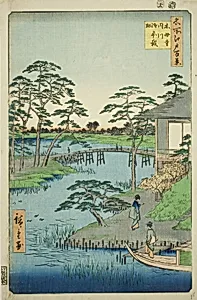
Mokubo Temple, Uchigawa Inlet, and Gozensaihata (Mokuboji Uchigawa Gozensaihata), from the series "One Hundred Famous Views of Edo (Meisho Edo hyakkei)"
Medium
Color woodblock print; oban
Classification
woodblock print
Department
Arts of Asia
Museum
Art Institute of Chicago
Accession Number
88437
Rights
Public Domain
Art Historical Context
In Utagawa Hiroshige's *Mokubo Temple, Uchigawa Inlet, and Gozensaihata* (1857), part of his iconic series *One Hundred Famous Views of Edo*, viewers are transported to a serene corner of Edo—modern-day Tokyo. This color woodblock print captures the Mokubo Temple perched above the tranquil Uchigawa Inlet, with vibrant Gozensaihata banners fluttering in the breeze, blending sacred architecture, natural waterways, and festive elements. Hiroshige, a master of the ukiyo-e ("pictures of the floating world") tradition, immortalized over 100 famed sites, offering a panoramic love letter to his hometown during the late Edo period. Printed in the large oban format, this work showcases Hiroshige's genius for atmospheric perspective and bold color layering, achieved through meticulous woodblock carving and multiple ink passes. The composition draws the eye from the foreground's lush greenery to the distant temple, evoking a sense of harmonious balance between human activity and nature—a hallmark of his lyrical landscape style. As Japan edged toward modernization, Hiroshige's series preserved the ephemeral beauty of traditional Edo life, influencing global artists like Van Gogh and Monet. Held in the Art Institute of Chicago's Arts of Asia collection, this print invites us to savor the quiet poetry of a bygone era.
About the Artist
Utagawa Hiroshige · 1826–1869
Utagawa Hiroshige (1797–1858), born Andō Tokutarō, was the last great master of Japanese ukiyo-e woodblock printmaking and one of the most influential landscape artists in history. Born in Edo (modern Tokyo) into a low-ranking samurai family serving as fire wardens, Hiroshige transformed landscape printmaking into a poetic meditation on nature, weather, and everyday life. His revolutionary approac...