
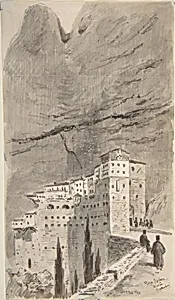
Monastery of Mega Spileon, Greece
1896
Medium
Pen and brown and black ink, brush and brown and gray ink, graphite, heightened with white gouache
Dimensions
8 x 4 9/16 in. (20.3 x 11.6 cm)
Classification
Drawings
Department
Drawings and Prints
Museum
Metropolitan Museum of Art, New York, NY
Credit
Gift of Emma Avery Welcher and Amy Ogden Welcher, 1965
Accession Number
65.639.26
Rights
Public Domain
Tags
Art Historical Context
Nestled dramatically against sheer cliffs in the Peloponnese region of Greece, the Monastery of Mega Spileonmeaning "Great Cave"—is one of the oldest continuously inhabited monasteries in the world, dating back to 4th century. artist Peter Toft captured timeless allure in this 1896 drawing, during a period when European artists increasingly traveled to the Mediterranean for inspiration. Toft's intimate sketch (8 x 4 9/16 in.) blends architectural grandeur with glimpses of human figures, evoking the daily life of monks amid rugged terrain. Toft employed a rich mixed-media technique: pen and brown/black ink for precise lines, brush and brown/gray ink for tonal depth, graphite for subtle shading, and white gouache highlights to mimic sunlight on stone and figures. This labor-intensive approach, common in 19th-century travel sketches, allowed for atmospheric effects and fine detail in a compact format, ideal for an artist's notebook. Now in the Metropolitan Museum of Art's Drawings and Prints collection (gift of Emma Avery Welcher and Amy Ogden Welcher, 1965), this work offers a window into late Ottoman-era Greece, highlighting the cultural endurance of Orthodox monasticism and Toft's eye for exotic European landscapes. Visitors will appreciate its blend of precision and poetry.