
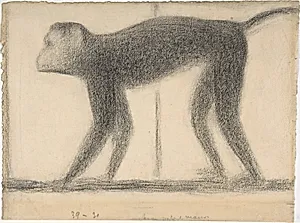
Monkey
1884
Medium
Conté crayon
Dimensions
12 1/4 x 9 3/8 in. (31.1 x 23.9 cm)
Classification
Drawings
Department
Drawings and Prints
Museum
Metropolitan Museum of Art, New York, NY
Credit
Bequest of Miss Adelaide Milton de Groot (1876-1967), 1967
Accession Number
67.187.35
Rights
Public Domain
Tags
Art Historical Context
Georges Seurat's *Monkey*, created in 1884, captures the artist's early mastery of conté crayon on paper, a medium he favored for its rich tonal range and velvety texture. This intimate drawing, measuring just 12¼ x 9⅜ inches, depicts a primate with precise contours and subtle hatching that evoke volume and life. Conté crayon, invented in the late 18th century, Seurat to blend graphite-like precision with charcoal's depth, techniques he honed during his student years at the École des Beaux-Arts. As a precursor to Seurat's revolutionary Pointillism—seen in masterpieces like *A Sunday on La Grande Jatte* (1884–86)—this work showcases his emerging obsession with scientific observation and form. Though focused on a single monkey, it reflects 19th-century fascination with exotic animals in zoos and circuses, symbols of the modern world's wonders. Seurat's drawings often served as studies for larger compositions, highlighting his methodical approach to light and structure. Now housed in the Metropolitan Museum of Art's Drawings and Prints department, thanks to the 1967 bequest of Adelaide Milton de Groot, *Monkey* invites visitors to appreciate Seurat's pre-Impressionist roots. It's a charming reminder of how everyday sketches laid the groundwork for Post-Impressionist innovation.
About the Artist
Georges Seurat · 1859–1891
Georges Seurat (1859-1891) was the founder of Neo-Impressionism and the inventor of Pointillism, a revolutionary technique that transformed how artists understand and apply color. In a tragically brief career cut short at age 31, Seurat produced only seven monumental paintings, yet his systematic application of color theory fundamentally altered the direction of modern art. Born in Paris to a pro...