
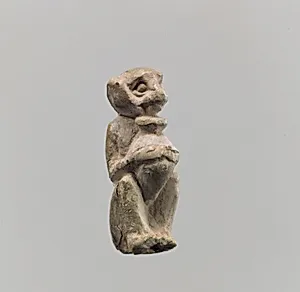
Monkey holding vessel
Unknown Artist
ca. 18th century BCE
Medium
Ivory
Dimensions
H. 2.2 x W. 0.9 cm (7/8 x 3/8 in.)
Classification
Ivory/Bone-Sculpture
Culture & Period
Old Assyrian Trading Colony · Middle Bronze Age–Old Assyrian Trading Colony
Department
Ancient Near Eastern Art
Museum
Metropolitan Museum of Art, New York, NY
Credit
Gift of Mrs. George D. Pratt, in memory of George D. Pratt, 1936
Accession Number
36.152.11
Rights
Public Domain
Tags
Art Historical Context
This exquisite ivory sculpture, titled *Monkey Holding Vessel*, dates to around the 18th century and hails from the Old Assyrian Trading Colony period in the Middle Bronze Age. Carved from elephant ivory—a prized luxury material traded across ancient Near Eastern networks—the figurine stands just 2.2 cm tall and 0.9 cm wide, showcasing the remarkable finesse of ancient artisans. Housed in the Metropolitan Museum of Art's of Ancient Near Eastern Art it was a gift from Mrs. George D. in memory of George D. Pratt in 1936. The Old Assyrian Trading Colony refers to bustling merchant outposts established by Assyrians from northern Mesopotamia in central Anatolia (modern Turkey), particularly at sites like Kültepe/Kanesh. These colonies thrived on long-distance trade in metals, textiles, and exotics like ivory, fostering cultural exchanges between Mesopotamian, Anatolian, and Levantine worlds. Small ivory carvings like this monkey—likely an inlay for furniture, a handle, or a ritual object—highlight the technical mastery of the era, with intricate details incised by hand using fine tools. Monkeys appear in Bronze Age art as symbols of exoticism and playfulness, possibly evoking distant trade partners or protective spirits. This tiny figure's vessel-holding pose invites curiosity about daily rituals or elite banquets, offering a window into a vibrant, interconnected ancient economy. A testament to enduring craftsmanship, it reminds us how even the smallest artifacts carry big stories.