
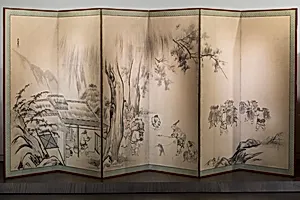
Monkey Trainers and Scenes of Chinese Life (耕作図屏風)
Edo period (1615–1868), 17th century
Medium
Ink and light colors on paper
Dimensions
Painting: 156 × 358 cm (61 7/16 × 141 in.); 170.4 × 372 cm (67 1/8 × 146 1/2 in.)
Classification
screen
Department
Arts of Asia
Museum
Art Institute of Chicago
Accession Number
158485
Rights
Public Domain
Art Historical Context
Kano Yasunobu’s Monkey Trainers and Scenes of Chinese Life is a striking example of Edo-period screen painting. Created in the 17th century, this large-format work uses delicate ink lines and subtle of color on paper to lively vignettes of daily. As a master of the Kano school—the hereditary atelier that served Japan’s military—Yasunobu blended Chinese-inspired compositions with the refined, decorative aesthetic favored by samurai patrons. Folding screens like this one functioned both as practical room dividers and as portable works of art in aristocratic households. The subject matter, drawing on Chinese themes of farming and entertainment, reflects the period’s deep admiration for continental culture while showcasing distinctly Japanese sensibilities in its rhythmic arrangement of figures across the broad surface. Viewers can appreciate the artist’s skillful control of ink tones, which gives the scenes a sense of depth and gentle movement. Measuring over three and a half meters wide, the screen invites close looking at its charming details—acrobatic monkeys, farmers at work, and bustling figures—revealing the playful yet elegant spirit of Kano painting at its height.
About the Artist
Kano Yasunobu (Japanese) · 1614 –1685
Japanese, 1614–1685