
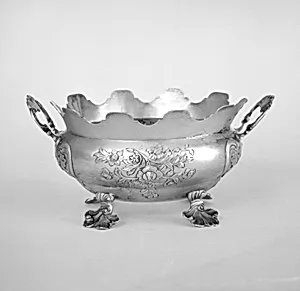
Monteith type oval bowl
Unknown Artist
ca. 1760
Medium
Silver gilt
Dimensions
Length: 8 1/4 in. (21 cm)
Classification
Metalwork-Silver
Culture
German, Brunswick (Braunschweig)
Department
European Sculpture and Decorative Arts
Museum
Metropolitan Museum of Art, New York, NY
Credit
The Lesley and Emma Sheafer Collection, Bequest of Emma A. Sheafer, 1973
Accession Number
1974.356.707
Rights
Public Domain
Art Historical Context
This elegant Monteith-type oval bowl, crafted around 1760 in Brunswick (Braunschweig), Germany, exemplifies the refined metalwork of 18th Europe. Produced during the Rococo era, when opulent decorative arts flourished among the nobility, this piece from the German duchy reflects the region's expertise in silver craftsmanship. Its modest length of 8¼ inches (21 cm) it was designed for intimate social gatherings, serving as both a functional vessel and a display of wealth. The silver gilt medium—fine silver coated with a thin layer of gold—creates a luxurious sheen that enhances its visual appeal while protecting the base metal from tarnish. The Monteith form, named after a 17th-century English fashion for notched rims (originally to suspend wine glasses by their feet), allowed for stylish punch service, blending utility with ornamentation. Though the artist remains unknown, the bowl's graceful oval shape and probable chased or embossed details highlight Brunswick's tradition of intricate silversmithing. Now part of The Metropolitan Museum of Art's European Sculpture and Decorative Arts collection, thanks to the Lesley and Emma Sheafer bequest of 1973, this bowl offers a glimpse into aristocratic leisure. It invites visitors to imagine candlelit salons where such treasures elevated everyday rituals into artful occasions.