
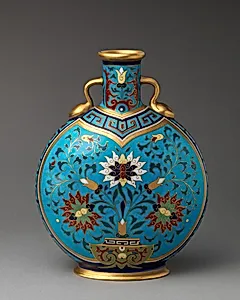
Moon flask with "cloisonné" floral decoration
1870–80
Medium
Bone china with enamel decoration and gilding
Dimensions
confirmed: 12 3/8 × 9 3/4 × 5 1/16 in., 4.3 lb. (31.4 × 24.8 × 12.9 cm, 2 kg)
Classification
Ceramics-Porcelain
Culture
British, Stoke-on-Trent, Staffordshire
Department
European Sculpture and Decorative Arts
Museum
Metropolitan Museum of Art, New York, NY
Credit
Gift of Helene Fortunoff and Robert Grossman, 2017
Accession Number
2018.62.4
Rights
Public Domain
Art Historical Context
This elegant moon flask, produced by the renowned British ceramics firm Minton(s) in Stoke-on-Trent, Staffordshire, between 1870 and 1880, exemplifies Victorian opulence in porcelain design. The bulbous, flask-like form—measuring 12⅜ × 9¾ × 5¹⁄₁₆ inches—draws inspiration from ancient Chinese ceramics, a nod to the era's fascination with Eastern aesthetics amid growing global trade. Crafted from fine bone china, prized for its translucency, strength, and creamy white body, it served as a luxurious decorative object for affluent homes. The flask's standout feature is its "cloisonné" floral decoration, achieved through intricate enamel painting and lavish gilding. This technique mimics the opulent metalwork of true cloisonné enamel—where designs are compartmentalized by thin wires—but adapts it brilliantly to porcelain, creating vibrant, cell-like patterns of blooming flowers. Minton(s), leaders in Staffordshire's pottery industry, showcased such innovations during the height of the Aesthetic Movement, blending industrial precision with artistic flair to rival imported luxuries. Housed in the Metropolitan Museum of Art's European Sculpture and Decorative Arts department (gift of Helene Fortunoff and Robert Grossman, 2017), this piece highlights Britain's ceramic mastery and cultural exchange in the late 19th century, inviting visitors to appreciate its delicate beauty up close.
About the Artist
Minton(s) · 1793–2001
Minton is among the most distinguished names in the history of British ceramics, a firm whose two and a quarter centuries of production encompass everything from blue transfer-printed earthenwares to the most rarefied decorative porcelain of the Victorian age. The company was founded in 1793 by Thomas Minton (1765–1836) in Stoke-upon-Trent, Staffordshire — the heart of England's pottery industry. ...