
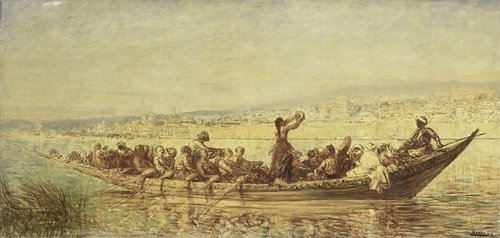
Moorse roeiers bij Constantinopel
1840 - 1900
Medium
oil on canvas
Dimensions
138; 15.4; 66.5; 3.9
Rights
Public Domain
About this artwork
signatuur, rechtsonder: ‘Ziem’
Art Historical Context
Félix Ziem's *Moorse roeiers Constantinopel* (Moorish Rowers at Constantinople), an oil on canvas from around 1840–1900, captures the vibrant allure of 19th-century Istanbul. Signed "Ziem" in the right, this panoramic work (66.5 × 138 cm) showcases the French artist's fascination with exotic harbors, where muscular Moorish rowers propel boats against a shimmering waterway. Ziem, a key figure in Romanticism and Orientalism, traveled to the Levant in the 1850s, drawing inspiration from the Ottoman city's bustling multiculturalism. Painted in loose, atmospheric brushstrokes typical of Ziem's luminous style, the piece evokes the golden light and misty horizons he mastered, blending European Romanticism with Eastern motifs. Oil on canvas allowed for rich impasto effects, heightening the sense of movement and heat. This scene reflects Europe's 19th-century "Orientalist" craze, romanticizing the "exotic Other" amid imperial expansions, yet Ziem's firsthand observations lend authenticity. Housed at the Rijksmuseum, it invites visitors to ponder the cultural exchanges along historic trade routes, where African, Arab, and European worlds converged on the Bosphorus. A testament to Ziem's wanderlust, it remains a vivid portal to a vanished imperial splendor.