
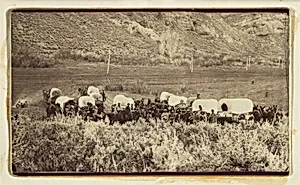
Mormon Emigrant Train, Echo Canyon
ca. 1870
Medium
Albumen silver print from glass negative
Dimensions
Image: 6.1 × 10.3 cm (2 3/8 × 4 1/16 in.)
Classification
Photographs
Department
Photographs
Museum
Metropolitan Museum of Art, New York, NY
Credit
Gilman Collection, Purchase, Marlene Nathan Meyerson Family Foundation Gift, 2005
Accession Number
2005.100.101
Rights
Public Domain
Tags
Art Historical Context
In the mid-19th century, waves of Mormon pioneers trekked westward to settle in Utah under Brigham Young's leadership, photographers like Charles William Carter captured their arduous journeys. *Mormon Emigrant, Echo Canyon* (ca. 1870) depicts a wagon train navigating the dramatic, narrow chasm of Echo Canyon, key passage on the Mormon Trail. Men, horses, and laden wagons snake through the rugged landscape, evoking the determination and faith that drove thousands from Nauvoo, Illinois, to the Salt Lake Valley between 1847 and 1869. Though created slightly later, Carter's image preserves the spirit of this transformative migration amid America's expanding frontier. Carter, a prominent Salt Lake City photographer, specialized in documenting Mormon life and Utah's wild terrains. This albumen silver print, made from a glass negative, showcases the era's cutting-edge wet-collodion process, yielding crisp details and warm tones from egg-white-coated paper. At just 6.1 × 10.3 cm, it's a compact yet vivid window into history, highlighting photography's role in shaping perceptions of westward expansion. Now in the Metropolitan Museum of Art's Gilman Collection, it invites us to ponder the human stories behind the pioneer mythos.