
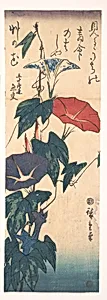
歌川広重画 朝顔|Morning Glories
ca. 1843
Medium
Woodblock print
Dimensions
12 15/16 x 4 3/8 in. (32.9 x 11.1 cm)
Classification
Prints
Culture & Period
Japan · Edo period (1615–1868)
Department
Asian Art
Museum
Metropolitan Museum of Art, New York, NY
Credit
Purchase, Joseph Pulitzer Bequest, 1918
Accession Number
JP265
Rights
Public Domain
Tags
Art Historical Context
In the vibrant world of Edo-period Japan (1615–1868), Utagawa Hiroige (1797–1858) captured fleeting beauty through ukiyo-e woodblock, or "pictures of the floating." This narrow-format print, *Morning Glories* (ca. 1843), showcases his mastery in depicting nature's delicate charms. Morning glories, or *asagao*, bloom vibrantly in summer but wilt by midday, symbolizing impermanence—a core theme in Japanese aesthetics like *mono no aware*. Hiroshige's composition fills the vertical space with twisting vines, lush leaves, and trumpet-shaped flowers in vivid blues and purples, rendered with precise lines and subtle gradations (*bokashi*) achieved through the woodblock process. Artisans carved multiple blocks for colors, allowing affordable mass production that brought art to everyday viewers, from merchants to samurai. Acquired by the Metropolitan Museum of Art in 1918 via the Joseph Pulitzer Bequest, this 12 15/16 x 4 3/8 in. treasure highlights Hiroshige's influence on Western artists like Van Gogh and Monet, bridging Eastern and global appreciation for nature's poetry.
About the Artist
Utagawa Hiroshige · 1826–1869
Utagawa Hiroshige (1797–1858), born Andō Tokutarō, was the last great master of Japanese ukiyo-e woodblock printmaking and one of the most influential landscape artists in history. Born in Edo (modern Tokyo) into a low-ranking samurai family serving as fire wardens, Hiroshige transformed landscape printmaking into a poetic meditation on nature, weather, and everyday life. His revolutionary approac...