
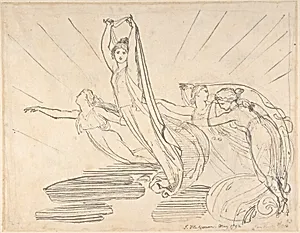
Morning: Pope's Odyssey, Book 12 (recto); Study for the final drawing (verso)
1792
Medium
Pen and gray ink over graphite
Dimensions
Sheet: 8 5/16 x 10 13/16 in. (21.1 x 27.5 cm)
Classification
Drawings
Department
Drawings and Prints
Museum
Metropolitan Museum of Art, New York, NY
Credit
Gift of Scott & Fowles, 1918
Accession Number
18.141.2
Rights
Public Domain
Tags
Art Historical Context
John Flaxman, a British neoclassical artist and sculptor, created this double-sided drawing in 1792 while in Rome, during his influential period producing illustrations for Alexander Pope's translation of Homer's *Odyssey*. The recto features "Morning: Pope's, Book 12," a pivotal scene likely involving Circe's warnings to Odysseus about perils like the Sirens and Scylla—evident from the tag highlighting women. The verso shows a preparatory study for the final composition, showcasing Flaxman's meticulous process. Executed in pen and gray ink over graphite on a modest 8 5/16 x 10 13/16 in. sheet, the work exemplifies Flaxman's signature linear style, inspired by ancient Greek vase painting and outline engravings. This technique emphasizes graceful contours and dynamic figures, blending classical purity with narrative clarity, which made his *Odyssey* illustrations hugely popular when published in 1793. A gift to the Metropolitan Museum of Art from Scott & Fowles in 1918, this drawing highlights Flaxman's role in reviving neoclassicism in Britain, bridging antiquity and Enlightenment ideals. Visitors will appreciate its intimate scale and the artist's innovative use of both sides, offering a window into epic storytelling through elegant draftsmanship.
About the Artist
John Flaxman · 1755–1826
John Flaxman (1755–1826) was born in York, England, the son of John Flaxman Sr., a moulder and seller of plaster casts who ran a studio in London's Covent Garden. Largely self-taught amid his father's stock of classical casts, with minimal formal schooling due to childhood illness, Flaxman displayed prodigious talent early on. At age 12, he won a Society of Arts prize for a medallion; by 15, anoth...