
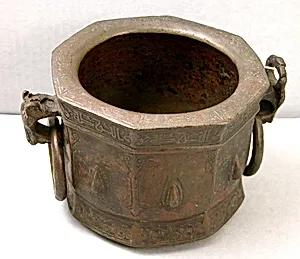
Mortar
Unknown Artist
12th–13th century
Medium
Bronze
Dimensions
H. 5 3/4 in. (14.6 cm) W. 9 5/16 in. (23.7 cm) D. 7 1/8 in. (18.1 cm)
Classification
Metal
Department
Islamic Art
Museum
Metropolitan Museum of Art, New York, NY
Credit
Rogers Fund, 1907
Accession Number
07.208
Rights
Public Domain
Tags
Art Historical Context
This bronze mortar, crafted by an unknown artist in the 12–13th century, the exquisite metalwork of the medieval Islamic world. Measuring 5¾ inches high and nearly 9½ inches wide, it was designed for grinding spices, herbs, or medicines—a practical vessel transformed into a work of art through skilled bronze casting. Housed in the Metropolitan Museum of Art's Art department (acquired via the Rogers Fund in 1907), its Arabic inscriptions suggest it originated from regions like Syria, Iraq, or Iran, where such objects were everyday essentials in kitchens and apothecaries. During the Islamic Golden Age, metalworkers mastered techniques like hammering, chasing, and engraving to adorn functional items with elegant Arabic script—often poetry, blessings, or owner dedications. This mortar's sturdy, bowl-like form with a short pedestal base highlights the blend of utility and aesthetics prized in Islamic craftsmanship, where even household tools reflected cultural sophistication and piety. Today, it offers a window into daily life across the medieval Islamic realms, reminding visitors how bronze's durability preserved these artifacts for centuries. A testament to anonymous artisans' genius, it underscores the Met's rich collection of Islamic metals.