
Mortar
Unknown Artist
19th century, after a 16th century Iberian model
Medium
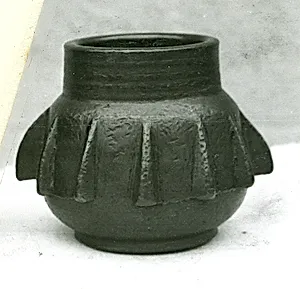
Copper alloy, pale olive color.
Dimensions
H. 9.6 cm, diam. 7.3 cm (rim).
Classification
Metalwork
Culture
Spanish or Moroccan (?)
Department
Robert Lehman Collection
Museum
Metropolitan Museum of Art, New York, NY
Credit
Robert Lehman Collection, 1975
Accession Number
1975.1.1364
Rights
Public Domain
Art Historical Context
This petite mortar, crafted in the 19th century from alloy with its distinctive pale olive patina, echoes the refined metalwork of a 16th-century Iberian original. Standing just 9.6 cm high with a 7.3 cm rim diameter, its compact form was ideal for grinding spices, herbs, or pigments in household or apothecary settings. The smooth, lustrous surface highlights the durability and aesthetic appeal of copper alloys, for their malleability and resistance to corrosion in everyday use. Dating to Spain's Renaissance era influences—blended with possible Moroccan artistry due to historic cultural exchanges in the Iberian Peninsula—this piece reflects a revival of earlier designs. The uncertainty in its origins (Spanish or Moroccan?) underscores the fluid artistic traditions across the Strait of Gibraltar, where Moorish techniques like casting and chasing persisted into the 19th century. Housed in the Robert Lehman Collection at The Metropolitan Museum of Art since 1975, this mortar exemplifies functional metalwork elevated to art. It invites us to appreciate how utilitarian objects carried cultural memory, bridging centuries of craftsmanship and daily life.