
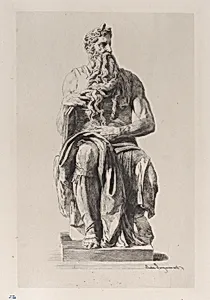
Moses, after Michelangelo
Medium
Etching, third state of five (Gonse)
Dimensions
Sheet: 17 5/16 in. × 12 in. (44 × 30.5 cm) Plate: 9 1/16 × 6 5/16 in. (23 × 16 cm)
Classification
Prints
Department
Drawings and Prints
Museum
Metropolitan Museum of Art, New York, NY
Credit
Gift of Louis R. Metcalfe, 1928
Accession Number
28.57.19
Rights
Public Domain
Tags
Art Historical Context
Behold the commanding presence of *Moses, after Michelangelo*, a masterful 1875 etching by French artist Jules-Ferdinand Jacquart, published in the prestigious *Gazette des Beauxts*. This print faithfully captures Michelangelo Buonarroti's iconic marble from the early 16th century, part of Pope Julius II's tomb in Rome's San Pietro in Vincoli church. Jacquemart's rendition brings the biblical prophet's muscular intensity, flowing beard, and piercing gaze—complete with the symbolic "horns of light" from ancient translations—to life on paper, measuring a precise plate of 9 1/16 × 6 5/16 inches. Etching, a technique Jacquemart excelled in, involves incising lines into a metal plate with acid, allowing for intricate details like the sculpture's tense veins and draped robes. This is the third state of five, as noted by scholar Louis Gonse, reflecting refinements in the printing process that enhanced tonal depth and clarity. In the 19th century, such reproductive prints democratized access to Renaissance masterpieces, educating artists, collectors, and the public amid a revival of classical ideals. A generous gift to the Metropolitan Museum of Art in 1928, this work exemplifies how prints bridge eras, preserving Michelangelo's High Renaissance genius for modern admirers. Gaze upon it and feel the prophet's unyielding strength!
About the Artist
Jules-Ferdinand Jacquemart|Gazette des Beaux-Arts|Michelangelo Buonarroti · 1837–1880
**Jules-Ferdinand Jacquemart: Master Etcher and Watercolorist** Jules-Ferdinand Jacquemart was born on September 7, 1837, in Paris to Albert Jacquemart, a prominent art collector, ceramics historian, and amateur artist, and Louise Émilie Labbé. The third of four children, he received his initial training in etching from his father, who had no formal master himself and emphasized self-taught preci...