
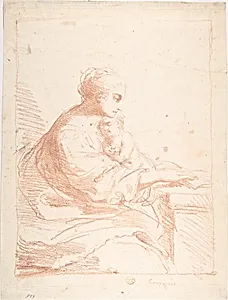
Mother and Child
Medium
Red chalk over traces of black chalk on cream paper
Dimensions
14-1/8 x 10-3/4 in. (35.9 x 27.3 cm)
Classification
Drawings
Department
Drawings and Prints
Museum
Metropolitan Museum of Art, New York, NY
Credit
Gift of Cephas G. Thompson, 1887
Accession Number
87.12.89
Rights
Public Domain
Tags
Art Historical Context
This tender drawing, *Mother and Child*, hails from 17th-century Italy, attributed to an anonymous artist of the Roman-Bolognese. Created in red chalk over traces of black on cream paper, it 14-1/8 x 10-3/4 inches and captures an intimate moment between a mother and infant—likely evoking the timeless Madonna and Child motif prevalent in Baroque art The soft, warm tones of red chalk lend a lifelike glow to the figures, highlighting the emotional bond and subtle modeling of forms that defined preparatory sketches of the era. In the 17th century, Roman-Bolognese artists, influenced by masters like the Carracci family and Guido Reni, excelled in drawing as a foundational practice for painting and sculpture. Red chalk was prized for its versatility in rendering flesh tones and drapery with naturalistic depth, making this work a fine example of studio technique. Such sheets often served as studies for larger religious or devotional compositions, reflecting the Counter-Reformation's emphasis on humanizing sacred subjects to inspire faith. Now housed in the Metropolitan Museum of Art's Department of Drawings and Prints, gifted by Cephas G. Thompson in 1887, this piece invites visitors to appreciate the quiet artistry behind grand masterpieces. It reminds us of motherhood's universal resonance across cultures and centuries.