
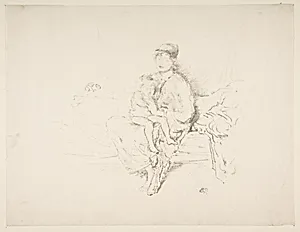
Mother and Child, No. 2
1891 and 1895
Medium
Transfer lithograph; only state (Chicago); printed in black ink on cream Japanese laid paper
Dimensions
image: 6 3/4 x 7 3/4 in. (17.1 x 19.7 cm) sheet: 8 3/4 x 11 3/8 in. (22.2 x 28.9 cm)
Classification
Prints
Department
Drawings and Prints
Museum
Metropolitan Museum of Art, New York, NY
Credit
H.O. Havemeyer Collection, Bequest of Mrs. H.O. Havemeyer, 1929
Accession Number
29.107.110
Rights
Public Domain
Tags
Art Historical Context
James McNeill Whistler, renowned 19th-century artist celebrated for his "art for's sake" philosophy and subtle tonal harmonies, created *Mother and Child, No 2* during his later years, with work spanning 1891 1895. This intimate transfer lithograph captures a tender moment between a mother and infant,oking universal themes of nurturing and quiet domesticity. Whistler's choice of subject reflects his fascination with everyday beauty, often infused with Japanese aesthetic influences, as seen in the delicate composition printed on cream Japanese laid paper. The medium—a transfer lithograph in its only known state (Chicago)—highlights Whistler's innovative printmaking prowess. He drew on transfer paper to achieve crisp, etching-like lines transferred to lithographic stone, then printed in black ink. This technique allowed for precise subtlety and multiplicity, bridging painting and print traditions during the Aesthetic movement. At just 6 3/4 x 7 3/4 inches, the image's small scale invites close contemplation, much like a whispered lullaby. Housed in the Metropolitan Museum of Art's Drawings and Prints department as part of the prestigious H.O. Havemeyer Collection (bequeathed in 1929), this work exemplifies Whistler's enduring impact on modern graphic arts, blending technical mastery with emotional resonance for generations of viewers.
About the Artist
James McNeill Whistler · 1834–1903
James Abbott McNeill Whistler (1834-1903) was an American-born painter and printmaker who became a leading figure in the Aesthetic Movement and pioneer of Tonalism and Japonisme. He revolutionized art by championing "art for art's sake" and treating paintings as visual equivalents of musical compositions, titling works as "arrangements," "harmonies," and "nocturnes" to emphasize formal qualities o...