
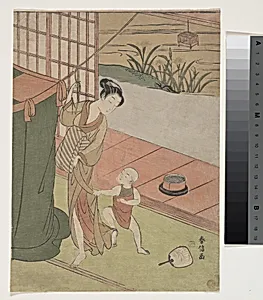
Mother and Son by a Mosquito Net
ca. 1769
Medium
Woodblock print; ink and color on paper
Dimensions
10 3/4 x 7 15/16 in. (27.3 x 20.2 cm) medium-size print (chu-ban)
Classification
Prints
Culture & Period
Japan · Edo period (1615–1868)
Department
Asian Art
Museum
Metropolitan Museum of Art, New York, NY
Credit
Purchase, Joseph Pulitzer Bequest, 1918
Accession Number
JP565
Rights
Public Domain
Tags
Art Historical Context
Suzuki Harunobu’s *Mother and Son by a Mosquito Net* (ca. 1769) captures a tender domestic moment from Japan’s Edo period. Created as a woodblock print in ink and color on paper, this medium-size chu-ban sheet reflects the everyday life scenes popular in ukiyo-e. Harunobu, renowned for pioneering full-color nishiki-e prints in the 1760s, brought delicate hues and graceful lines to such intimate subjects, elevating prints from simple illustrations to refined art. The composition shows a mother gently attending to her child beside a draped mosquito net, a common household feature in summer. This quiet scene highlights the close bond between parent and child while evoking the rhythms of daily life in 18th-century Japan. Harunobu’s elegant figures and soft palette convey warmth and tranquility, inviting viewers to appreciate the beauty found in ordinary moments. As part of the Metropolitan Museum’s collection of Asian art, the print exemplifies how ukiyo-e artists blended technical innovation with cultural observation, preserving glimpses of Edo society for generations.
About the Artist
Suzuki Harunobu · 1725–1770
Suzuki Harunobu (c. 1725-1770) was a Japanese ukiyo-e artist who revolutionized woodblock printing by developing nishiki-e—full-color prints using multiple woodblocks—in 1765. Before Harunobu, Japanese prints were limited to two or three colors; his innovation unleashed the entire artist's palette, transforming ukiyo-e into the vibrant art form that would later captivate Western artists from Manet...