
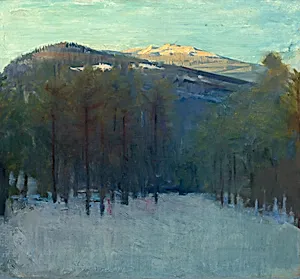
Mount Monadnock
probably 1911/1914
Medium
oil on canvas
Dimensions
overall: 56.4 × 61.4 cm (22 3/16 × 24 3/16 in.) framed: 78.4 × 83.2 × 6.7 cm (30 7/8 × 32 3/4 × 2 5/8 in.)
Classification
Painting
Department
CAB
Museum
National Gallery of Art, Washington, D.C.
Credit
Corcoran Collection (Museum Purchase, Anna E. Clark Fund)
Accession Number
2014.79.34
Rights
Public Domain
Art Historical Context
Abbott Handerson Thayer's *Mount Monadnock* (probably 1911/1914) captures the majestic presence of New Hampshire's iconic granite peak, a subject that captivated the artist throughout his career. Thayer, an American painter known for his luminous landscapes and portraits infused with idealism, viewed Monadnock as a spiritual emblem of nature's harmony. This oil on canvas, measuring 56.4 × 61.4 cm, exemplifies his late style, blending precise realism with subtle tonal effects reminiscent of Tonalism and the Barbizon school's reverence for unspoiled wilderness. Painted during a period when Thayer was also pioneering theories on animal camouflage—ideas that influenced World War I military tactics—the work reflects his fascination with natural forms and light. The medium of oil allowed Thayer to layer translucent glazes, achieving a glowing, ethereal quality that evokes the mountain's timeless allure under shifting skies. Its intimate scale invites viewers to contemplate the sublime in everyday vistas. Now part of the National Gallery of Art's Corcoran Collection (acquired through the Anna E. Clark Fund), this painting celebrates early 20th-century American regionalism, bridging Romantic traditions with modern observation. A perfect gem for pondering humanity's place in the wild.