
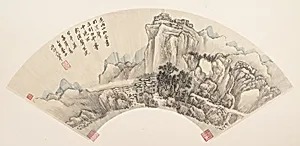
清 王翬 雨後晴巒圖 扇頁|Mountains after Rain
dated 1695
Medium
Folding fan mounted as an album leaf; ink and color on paper
Dimensions
6 7/16 x 19 3/8 in. (16.4 x 49.2 cm)
Classification
Paintings
Culture & Period
China · Qing dynasty (1644–1911)
Department
Asian Art
Museum
Metropolitan Museum of Art, New York, NY
Credit
Bequest of John M. Crawford Jr., 1988
Accession Number
1989.363.144
Rights
Public Domain
Tags
Art Historical Context
Wang Hui's *Mountains after Rain* (169), a delicate folding fan remounted as an album leaf captures the serene beauty of a post-rain landscape in ink and color on paper. As one of the Qing dynasty's (1644–1911) most celebrated painters, Wang Hui (1632–1717) was a leading figure in the orthodox school, drawing inspiration from Song and Yuan masters to revive classical Chinese landscape traditions. This intimate 6 7/16 x 19 3/8 in. work exemplifies his mastery, blending misty peaks, lush trees, and humble houses into a harmonious vista evoking nature's rejuvenation. The fan format was hugely popular in elite Chinese circles, serving as both a functional accessory and a showcase for personal artistry. Wang Hui's precise brushwork—layered washes for atmospheric depth and fine lines for foliage—creates a sense of vastness within a small space, a hallmark of his meticulous "professional" style over more expressive literati approaches. Dated precisely to 1695, this piece reflects the Qing era's cultural flourishing under imperial patronage, where such paintings symbolized harmony between humanity and the cosmos. Today, housed in the Metropolitan Museum of Art's Asian Art department through the bequest of John M. Crawford Jr. (1988), it invites viewers to ponder the enduring appeal of China's mountain imagery, timeless emblems of transcendence and tranquility.
About the Artist
Wang Hui · 1632–1717
Chinese, 1632–1717