
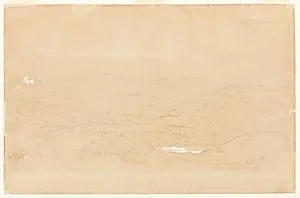
Mountains near Guanujo and Guaranda, Ecuador
June 10, 1857
Medium
landscapes
Classification
landscapes
Department
Smithsonian Collection
Museum
Smithsonian American Art Museum
Credit
Gift of Louis P. Church
Accession Number
1917-4-737-b
Rights
Public Domain
About this artwork
Research in Progress
Art Historical Context
Frederic Edwin Church, leading figure of the Hudson River School, the majestic Andes in *Mountains near Guanujo and Guar, Ecuador* on June 10, 1857, during his second expedition to South America. by explorer Alexander von Humboldt's romantic visions of equatorial nature, Church sketched directly from life amid Ecuador's volcanic peaks, blending scientific observation with awe-inspiring grandeur. This on-site work reflects his passion for documenting untouched wilderness, a hallmark of 19th-century American landscape art. As a landscape study—likely an oil sketch—the painting exemplifies Church's meticulous technique: luminous atmospheric effects, precise geological details, and dramatic light that evoke the sublime power of nature. It served as source material for his monumental studio canvases, like *The Heart of the Andes* (1859), bridging fieldwork and idealism. Created amid political unrest in Ecuador, it underscores Church's adventurous spirit and the era's fascination with exotic locales. Today, this gem graces the Smithsonian American Art Museum, gifted by Church's son, Louis P. Church. It invites visitors to ponder humanity's place in vast, volatile landscapes, a timeless theme in American art. (198 words)