
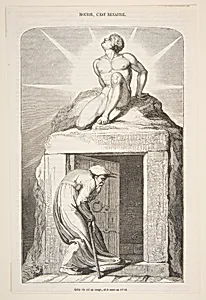
Mourir C'est Renaitre (Death and Immortality)
19th century
Medium
Wood engraving
Dimensions
plate: 8 7/8 x 5 5/8 in. (22.5 x 14.3 cm) sheet: 10 x 6 5/8 in. (25.4 x 16.8 cm)
Classification
Prints
Department
Drawings and Prints
Museum
Metropolitan Museum of Art, New York, NY
Credit
Harris Brisbane Dick Fund, 1932
Accession Number
32.36.67
Rights
Public Domain
Tags
Art Historical Context
*Mourir C'est Ren (Death and Immortality is a striking wood engraving from the early 19th century, as part of William Blake's visionary illustrations for Robert Blair's 1743 poem *The Grave*. Blake, pioneering Romantic artist and poet, designed this image, which captures the poem's meditation on death as a gateway to eternal life. The title, translating from French as "To Die is to be Reborn," evokes a nude male figure emerging triumphantly through grand doors—symbolizing the soul's passage from mortality to immortality. Measuring a modest plate size of 8 7/8 x 5 5/8 inches, it was produced via precise wood engraving techniques, ideal for book illustrations that blended text and image seamlessly. Blake's style, rooted in mysticism and biblical prophecy, infuses the work with dramatic tension and spiritual fervor. The open doors and ethereal nude form highlight themes of resurrection, resonating with Romantic-era fascination with the sublime and the afterlife. Engraved after Blake's designs (often by collaborators like Luigi Schiavonetti), these prints from the 1808 edition gained wide popularity, bridging poetry and visual art. Acquired through the Harris Brisbane Dick Fund in 1932, this piece from The Metropolitan Museum of Art's Drawings and Prints department invites visitors to ponder life's profound mysteries. Its compact power reminds us how Blake transformed grim subjects into visions of transcendent hope.
About the Artist
Robert Blair|William Blake (British|British) · 1757 |1699 –1827 |1746
British, London 1757–1827 London|British, 1699–1746