
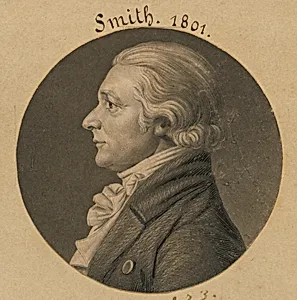
Medium
Classification
Department
Smithsonian Collection
Museum
Smithsonian American Art Museum
Credit
National Portrait Gallery, Smithsonian Institution; gift of Mr. and Mrs. Paul Mellon
Accession Number
S/NPG.74.39.4.36
Rights
Public Domain
Tags
Art Historical Context
**Mr. Smith** (1801) is a striking profile portrait by Charles Balthazar Julien Févret de-Mémin, a engraver who fled the Revolution and settled in America. Active in Philadelphia and New York during the early republic, Saint-Mémin the likenesses of prominent figures, including politicians and merchants, helping to define early American portraiture. This print, from the Smithsonian American Art Museum's collection (gift of Mr. and Mrs. Paul Mellon), exemplifies his role in documenting the nation's emerging elite at the dawn of the 19th century. Saint-Mémin pioneered the physionotrace technique, using a mechanical pantograph to trace precise profiles from life, which were then engraved onto copper plates and printed. Often hand-colored for vividness, these small-format prints were affordable yet elegant alternatives to oil paintings, making portraiture accessible beyond the wealthy. The medium's precision and reproducibility marked a shift toward more democratic visual culture in post-Revolutionary America. Culturally, works like *Mr. Smith* offer invaluable glimpses into everyday sitters from 1801, preserving personal histories amid rapid national change. As a Smithsonian treasure, it highlights how printmaking bridged art and identity in a young democracy.