
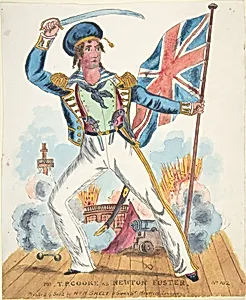
Mr. T. P. Cooke as Newton Foster
19th century
Medium
Watercolor, pen and black ink, over graphite
Dimensions
sheet: 9 5/16 x 7 5/8 in. (23.6 x 19.3 cm)
Classification
Drawings
Department
Drawings and Prints
Museum
Metropolitan Museum of Art, New York, NY
Credit
Purchase, Anne and Carl Stern Gift, 1965
Accession Number
65.551.4(5)
Rights
Public Domain
Tags
Art Historical Context
Behold *Mr. T. P. Cooke as Newton Foster*, captivating 19th-century British drawing that captures the dramatic flair of Victorian theater. Created anonymously using watercolor, pen and black over graphite on a modest sheet measuring 9 5/16 x 7 5/8 inches, this portrait depicts the popular actor Thomas Potter Cooke in the role of Newton Foster—a character likely from a military melodrama, as suggested by tags evoking soldiers, men, flags. Such works were cherished mementos for theatergoers, blending portraiture with performance. The mixed-media technique showcases the artist's skill: graphite underdrawing provides precise structure, pen and ink add sharp contours and details to Cooke's uniform and props, while watercolor brings vibrant life to fabrics and flesh tones. This layered approach was common in British drawings of the era, allowing for nuanced expression in small-scale formats suited to albums or private collections. Housed in the Metropolitan Museum of Art's Drawings and Prints department (purchased with the Anne and Carl Stern Gift in 1965), this piece offers a window into 19th-century popular culture, where actors like Cooke became national heroes through soldierly roles amid Britain's imperial and Napoleonic afterglow. It reminds us how theater immortalized everyday valor.
About the Artist
Anonymous, British, 19th century · 1800–1900
**Anonymous, British, 19th century** is not the name of a single individual but a standard museum attribution used for works whose creators remain unidentified yet are clearly British and date to the 1800s. Major institutions, including the Metropolitan Museum of Art, employ this designation for hundreds of drawings, prints, designs, and decorative studies that lack signatures or firm documentary ...