
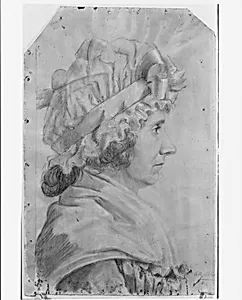
Mrs. George Clinton (Cornelia Tappen)
Medium
Conté crayone, charcoal (?), and white-chalk heightening on off-white laid paper coated with gouache
Dimensions
21 3/8 x 13 3/4 in. (54.3 x 34.9 cm)
Classification
Drawing
Culture
American
Department
The American Wing
Museum
Metropolitan Museum of Art, New York, NY
Credit
Purchase, Anonymous Gift, 1940
Accession Number
40.167.2
Rights
Public Domain
Tags
Art Historical Context
This elegant profile portrait of Mrs. Clinton, née Cornelia Tappen (ca. 1797), the poise of an early American gentlewoman. Created by French émigré artist Charles Balthazar Julien Fret de Saint-Mé in collaboration with Thomas Bluget Valdenuit, it the wife of George Clinton, New York's influential first governor and later U.S. vice president. Rendered in the Federal-era style, such profiles evoked classical antiquity—inspired by Roman coins and cameo silhouettes—symbolizing republican virtue amid the young nation's post-Revolutionary identity. Saint-Mémin pioneered a mechanical "physionotrace" process in America, tracing sitters' profiles with a pantograph for precision before enhancing them by hand. Here, Conté crayon and possible charcoal delineate sharp contours on gouache-coated laid paper, with white-chalk heightening adding luminous highlights to the subject's lace-trimmed attire and powdered coiffure. Measuring 21⅜ × 13¾ inches, this labor-intensive mixed-media technique produced refined, reproducible likenesses popular among the elite, bridging European portraiture traditions with emerging American sensibilities. Housed in The Metropolitan Museum of Art's American Wing, the work exemplifies late 18th-century cultural aspirations, blending Old World finesse with New World optimism. Visitors will appreciate its intimate scale and technical virtuosity, offering a window into the refined world of Federal New York society.