
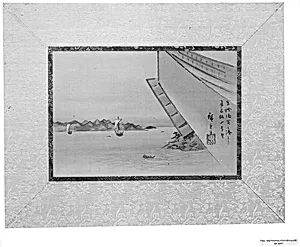
Mt. Nokogiri Seen from a Distance
Utagawa Hiroshige, 19th century
About this artwork
Utagawa Hiroshige1797–1858), one of Japan's most celebrated ukiyo-e artists masterfully captures the serene beauty of nature in *Mt. Nokogiri Seen a Distance*. Created during the Edo period (5–1868), this intimate matted painting on silk depicts the iconic jagged peaks of Mount Nokogiri— as "Saw Mountain" for its serrated silhouette—rising dramatically from the misty horizon. Small boats dot the foreground waters, evoking the everyday life of coastal travelers and fishermen, a hallmark of Hiroshige's ability to blend human activity with vast landscapes. Rendered in delicate ink and vibrant colors on luxurious silk, the work showcases traditional Japanese painting techniques like subtle gradations of wash (mizu-iro) for atmospheric depth and fine brushwork to suggest distance and impermanence. Unlike Hiroshige's famous woodblock prints, such as *The Fifty-three Stations of the Tōkaidō*, this hand-painted piece highlights his painterly finesse, reserved for elite patrons. The compact size (8¼ × 12⅛ in.) made it ideal for private contemplation in a tokonoma alcove. A gift to the Metropolitan Museum of Art in 1908, this Edo-era gem reflects Japan's flourishing urban culture, where art celebrated seasonal beauty and wabi-sabi aesthetics. Visitors will appreciate how Hiroshige invites us to pause and savor the quiet poetry of a distant mountain view.