
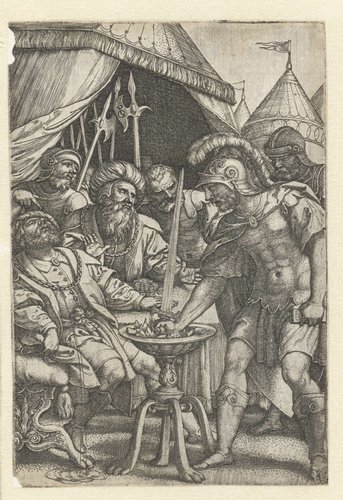
Mucius Scaevola steekt rechterhand in het vuur
1535
Medium
engraving
Dimensions
74; 115
Rights
Public Domain
About this artwork
collector's mark: ‘Hinloopen’ Lugt 11
Art Historical Context
Behold Georg Pencz's striking 1535 engraving *Mucius Scaevola steekt rechterhand in het vuur* (Mucius Scaevola Thrusts His Right Hand into the Fire), a compact masterpiece measuring just 115 mm high by 74 mm wide. This German Renaissance artist, one of the renowned "Little Masters" alongside Albrecht Dürer and others, specialized in intricate small-scale engravings that captured classical tales with remarkable precision. Pencz's style blends Northern detail with Italian Renaissance humanism, making complex narratives accessible to collectors and scholars. The scene dramatizes the ancient Roman legend of Gaius Mucius Scaevola, who boldly burned his own hand on a sacrificial altar to prove his unyielding loyalty after failing to assassinate the Etruscan king Porsena around 508 BCE. This act of stoic courage symbolized Roman virtus (manly excellence), a theme revived during the Renaissance to inspire moral fortitude. Pencz's engraving technique—incising fine lines into a copper plate for inked impressions—allowed for exquisite textures, from flickering flames to Scaevola's resolute expression, enabling widespread dissemination of such heroic stories. Adorned with the collector's mark of Jan Hinlopen (Lugt 11), this print boasts prestigious provenance from a 17th-century Amsterdam collector. A testament to engraving's role in preserving antiquity, it invites us to ponder timeless ideals of bravery amid the era's rediscovery of classical lore.
About the Artist
Georg Pencz · 1490–1550
Comment on works: Religious; History; Portraits