
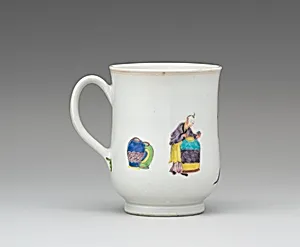
Mug
ca. 1770
Medium
Hard-paste porcelain
Dimensions
Height: 4 11/16 in. (11.9 cm)
Classification
Ceramics-Porcelain
Culture
British, Bristol
Department
European Sculpture and Decorative Arts
Museum
Metropolitan Museum of Art, New York, NY
Credit
The Charles E. Sampson Memorial Fund, 1965
Accession Number
65.31
Rights
Public Domain
Tags
Art Historical Context
This delicate mug, crafted around 1770 by the pioneering British porcelain maker William Cookworthy in association with Bristol potteries, exemplifies early English hard-paste porcelain. Standing just 4 11/16 inches tall, it produced during a pivotal moment in British ceramics history. Cookworthy, a Quaker pharmacist, discovered Cornish kaolin—the key ingredient for true hard-paste porcelain—in 1756, breaking Europe's dependence on Chinese imports. His Plymouth and Bristol factories (1768–1771) marked Britain's first successful production of this durable, translucent material, rivaling Meissen and Sèvres wares. Adorned in the fashionable chinoiserie style, the mug features whimsical scenes of men and women in imagined Oriental attire, painted in vibrant enamels overglaze. Chinoiserie, a rococo-era craze in 18th-century Europe, blended exotic Chinese motifs with Western fantasy, adorning everything from teacups to grand interiors. This everyday object transformed the utilitarian mug into a status symbol for affluent households, showcasing technical virtuosity in firing and decoration amid the height of the porcelain mania. Today, housed in The Metropolitan Museum of Art's European Sculpture and Decorative Arts collection, this piece highlights Britain's industrial ambition and cultural fascination with the East, reminding us how a simple cup fueled artistic innovation.
About the Artist
Cookworthy|Bristol ( |British) · | – |
|British