
Mug
c. 1940
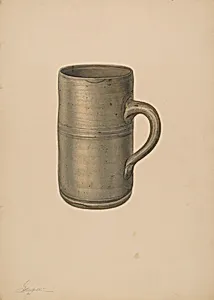
Medium
watercolor, colored pencil, and graphite on paperboard
Dimensions
overall: 35.4 x 25.4 cm (13 15/16 x 10 in.) Original IAD Object: 6 1/2" High 4" Dia.
Classification
Index of American Design
Department
CG-W
Museum
National Gallery of Art, Washington, D.C.
Credit
Index of American Design
Accession Number
1943.8.5096
Rights
Public Domain
Art Historical Context
Behold the exquisite rendering of a humble *Mug* by Giacinto Capelli, around 1940 as part of the Index of American Design (IAD). This detailed, colored pencil, and graphite study on paperboard (35.4 x 25.4 cm) meticulously captures a modest original object—6½ inches high and 4 inches in diametershowcasing everyday American craftsmanship from an earlier era. Housed in the National Gallery of Art, exemplifies the precision of Capelli's hand in translating three-dimensional form into vibrant, lifelike two dimensions. The IAD, a Works Progress Administration (WPA) project during the Great Depression, commissioned artists like Capelli to document America's rich folk art and design heritage through over 15,000 such renderings. Completed amid economic hardship, these works preserved cultural artifacts at risk of loss, blending artistic skill with scholarly documentation. Capelli's mixed-media technique—layering translucent watercolors for depth, precise colored pencils for texture, and graphite for fine lines—highlights subtle contours, glazes, and proportions, turning a simple mug into a testament to vernacular ingenuity. This piece invites us to appreciate the beauty in the ordinary, reflecting how American design wove functionality with quiet artistry. A snapshot of 20th-century preservation efforts, it reminds visitors of our shared material history.
About the Artist
Giacinto Capelli · 1855–present
**Giacinto Capelli** (American, active c. 1935–1942) contributed significantly to the documentation of American material culture through his precise watercolor renderings as part of the Index of American Design, a Federal Art Project under the Works Progress Administration (WPA). Little is known about his early life or formal training, which remains sparsely documented, though his expertise in wat...