
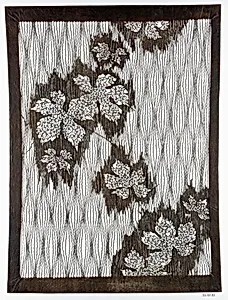
Mulberry Leaves with Ivy
Unknown Artist
19th century
Medium
Paper and silk
Dimensions
20 1/2 x 15 1/2 in. (52.07 x 39.37 cm)
Classification
Stencils
Culture
Japan
Department
Asian Art
Museum
Metropolitan Museum of Art, New York, NY
Credit
Gift of Clarence McKenzie Lewis, 1953
Accession Number
53.101.63
Rights
Public Domain
Tags
Art Historical Context
This delicate stencil, *Mulberry Leaves with Ivy hails from 19th-century Japan and exemplifies the exquisite craftsmanship of katagami, traditional stencils used in textile dyeing. Crafted from layered paper and silk, it 20½ x 15½ inches and captures the intricate veins and textures of mulberry leaves intertwined with ivy in a naturalistic design. Mulberry, central to Japan's silk industry as food for silkworms, a layer of cultural resonance, evoking the nation's deep ties to sericulture and seasonal beauty. Katagami stencils were meticulously hand-cut by skilled artisans, often using knives and silk threads to reinforce delicate areas and prevent tearing during repeated use. Applied with rice paste resist-dyeing techniques like yuzen, they enabled vibrant, multi-color kimono patterns that defined Edo and Meiji-era fashion. This piece's precision highlights the anonymous master's mastery of negative space, where cutouts allow dye to permeate fabric, creating luminous effects. Now in the Metropolitan Museum of Art's Asian Art Department—thanks to a 1953 gift from Clarence McKenzie Lewis—this stencil offers a window into Japan's artisanal heritage. It reminds us how everyday motifs like leaves symbolized renewal and harmony with nature, bridging art, craft, and daily life in imperial Japan.