
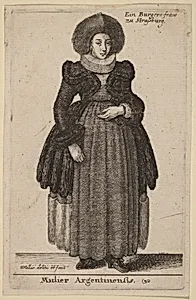
Mulier Argentinensis
1601 to 1650
Medium
etching
Classification
Department
CG-E
Museum
National Gallery of Art, Washington, D.C.
Credit
Rosenwald Collection
Accession Number
1943.3.5001
Rights
Public Domain
Art Historical Context
Wenceslaus Hollar's *Mulier Argentinensis*, an exquisite etching from the mid-17th century (ca. 1601–1650), captures the poised elegance of a woman from—known in antiquity as Argentoratum. Hollar, a Bohemian master printmaker (1607–7), was renowned for his meticulous documentation of European life during the tumultuous Thirty Years' War era. Exiled from Prague, he in England and Antwerp, producing over 2,500 prints that chronicled costumes, architecture, and daily scenes with remarkable precision. This print exemplifies Hollar's etching technique, where a needle scratches fine lines into a copper plate, bitten by acid to create tonal depth and texture. The medium allowed intricate details—like the woman's lace collar, embroidered sleeves, and headdress—that highlight 17th-century fashion and regional identity. As part of Hollar's broader interest in national attire, it offers a window into cultural diversity across Europe. Housed in the National Gallery of Art's Rosenwald Collection (Department CG-E), *Mulier Argentinensis* invites visitors to appreciate how prints democratized art, making high-society portraits accessible. Hollar's work bridges Baroque realism and topography, preserving a vanishing world of tradition amid historical change.
About the Artist
Wenceslaus Hollar · 1607–1677
Wenceslaus Hollar (1607-1677) was a prolific Bohemian etcher who became one of the most accomplished printmakers of the seventeenth century. Born in Prague, he trained under Matthäus Merian in Frankfurt before entering the service of Thomas Howard, Earl of Arundel, in 1636. Hollar spent most of his career in England, where he produced approximately 2,740 etchings documenting an extraordinary range...